

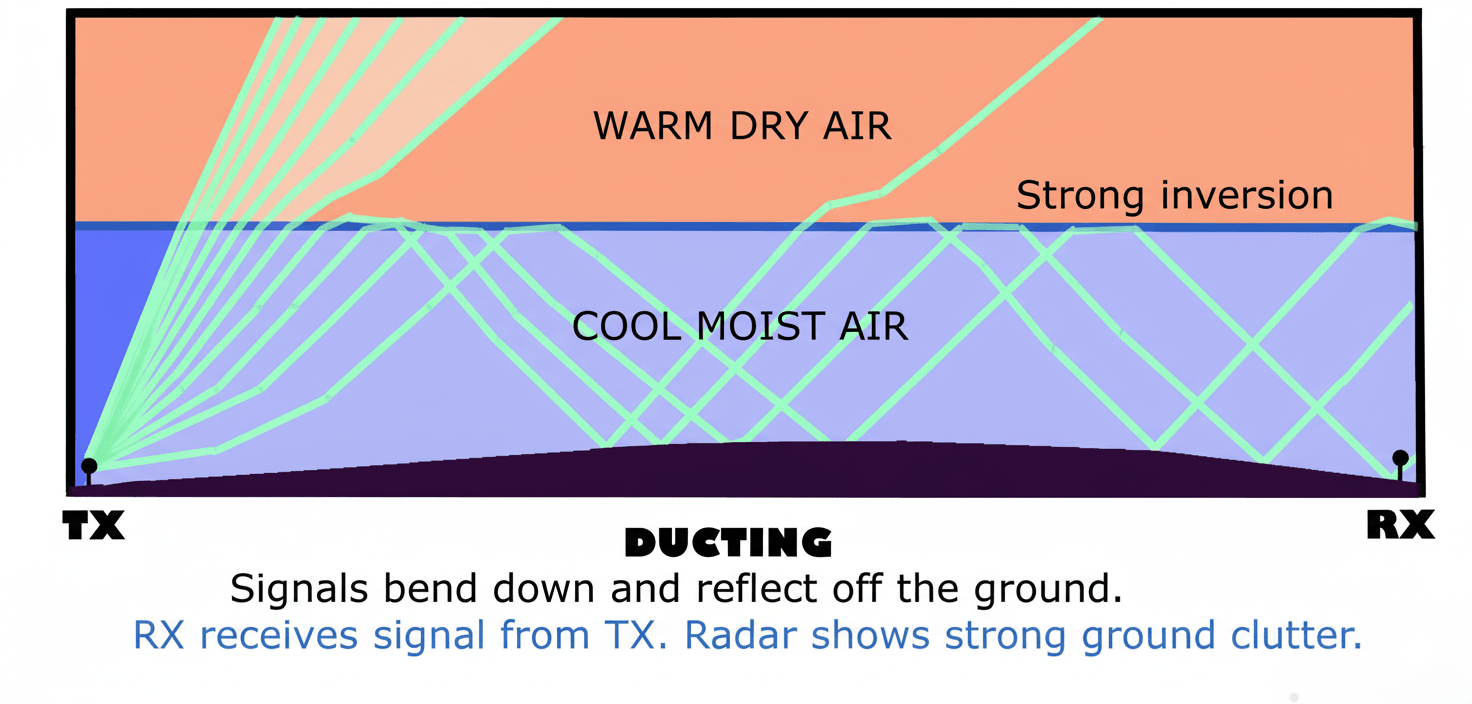
Today, August 10, 2025, many public safety agencies operating in the 482–488 MHz range are experiencing severe radio communications issues. These disruptions are being caused by atmospheric conditions, specifically a phenomenon known as tropospheric ducting. This occurs when radio signals are bent back toward the Earth due to temperature inversions and pressure differences in the ionosphere / troposphere.
Understanding the Current Radio Communications Crisis
Today, August 10, 2025, many public safety agencies operating in the 482–488 MHz range are experiencing severe radio communications issues. These disruptions are being caused by atmospheric conditions, specifically a phenomenon known as tropospheric ducting. This occurs when radio signals are bent back toward the Earth due to temperature inversions and pressure differences in the ionosphere / troposphere.
Under normal conditions, UHF radio signals dissipate into space and do not return to Earth. However, during tropospheric ducting, these signals can bounce back unpredictably, potentially causing interference and reception issues over long distances.
Impact on Massachusetts Public Safety Agencies
These effects vary depending on frequency and geographic location. In Massachusetts, many public safety agencies operate within one of four UHF bands: 453/458 MHz, 460/468 MHz, 470–476 MHz, and 482–488 MHz. The two upper bands, also known as T-BAND, 470–488 MHz—fall within the television broadcast spectrum, specifically corresponding to TV channels 13 and 16. In Massachusetts, this spectrum has been reallocated for public safety use, adding approximately 12 MHz of spectrum for public safety communications.
While tropospheric ducting (also known as “skip”) can affect any radio frequency, it is particularly noticeable for agencies operating in the shared TV (T-BAND) spectrum between 470–488 MHz. The Greater Boston Area, especially southeastern Massachusetts, is currently experiencing significant interference due to this phenomenon.
Current Conditions and Forecast
According to the NOAA forecast from August 10, these conditions are expected to persist until August 12, 2025.
Agencies using the 482–488 MHz band are currently facing periods of complete radio blackout. This is largely due to high-power digital TV station signals being ducted off the ionosphere and into the region. These blackout conditions are expected to continue intermittently over the next few days.
Immediate and Long-Term Solutions
In the short term, agencies should coordinate shared usage with neighboring departments or utilize mutual aid channels operating on UHF bands that are not in the 482–488 MHz range.
Long term, a more sustainable solution is to migrate away from the 482–488 MHz band entirely. However, due to the limited availability of spectrum in the UHF range, this is a complex challenge. Agencies should begin considering long-term solutions using the 700 MHz spectrum, which the FCC has allocated exclusively for public safety use.
In my interpretation, the FCC has made it clear that users experiencing interference in the T-Band (470–512 MHz) are expected to transition to the 700 MHz spectrum. Unfortunately, this means the FCC is unlikely to act against high-power digital TV stations operating in the 482–486 MHz band, even if they are causing interference from ducting. In effect, this tropospheric phenomenon is acting as a kind of unfunded mandate, pushing agencies to migrate.
Looking Ahead
There is little that radio technicians can do to address this issue in the short term, it must simply be waited out. In my opinion, it is time to seriously consider moving off the T-Band, especially as these atmospheric conditions seem to be occurring more frequently and lasting longer.
I hope readers find this information useful.